
The Ultimate Miata Road Trip Guide to the UK: Everything American Enthusiasts Need to Know
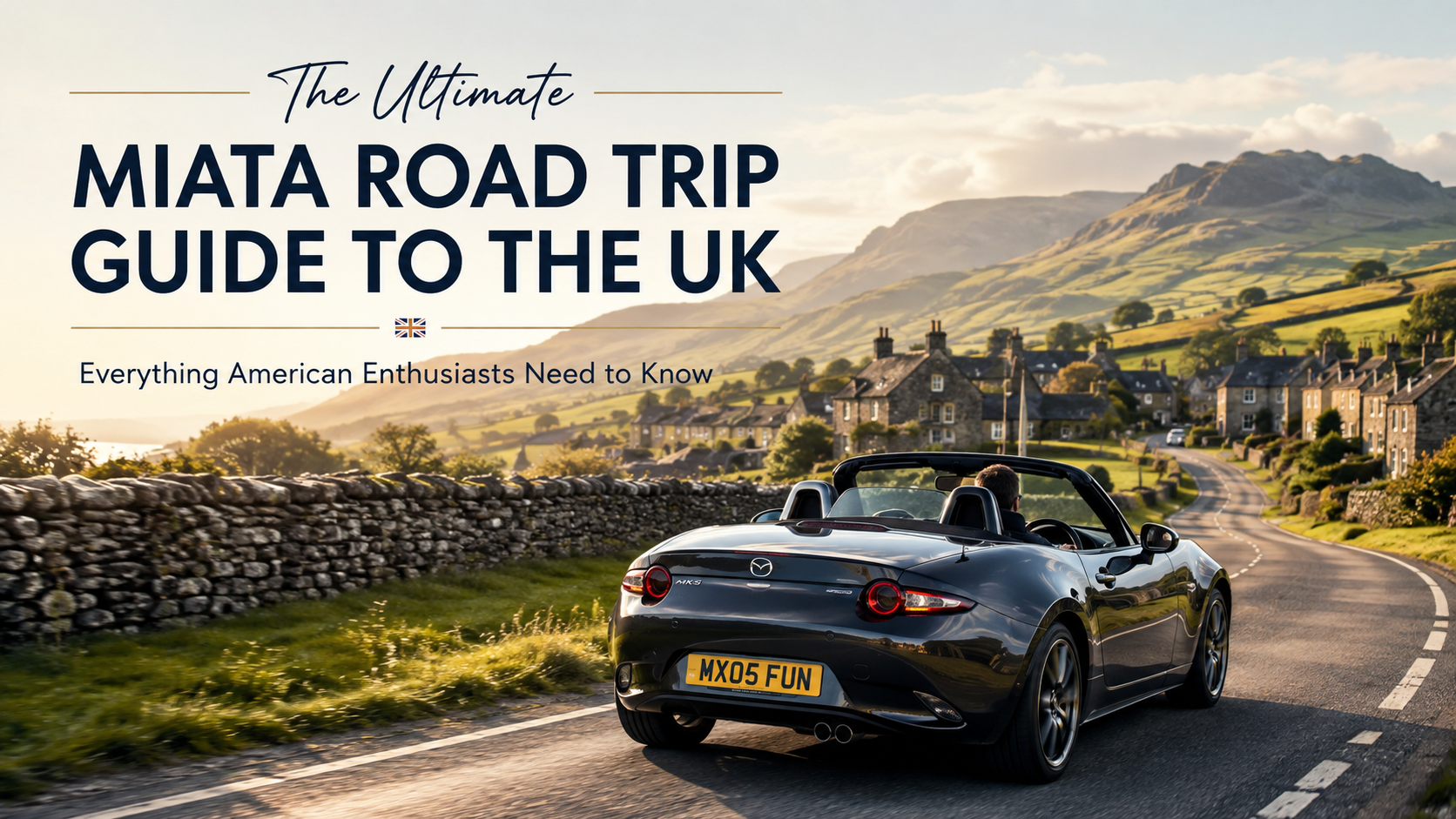
Book your flights and lets go!
For any true automotive enthusiast, the Mazda Miata (known as the MX-5 over here in Britain) represents the absolute pinnacle of lightweight, open-top driving. But while the US has amazing stretches like the Tail of the Dragon, the Miata was fundamentally inspired by the classic British roadster. To truly experience what this car was engineered for, you need to drive it on the tight, undulating, and stone-walled ribbons of asphalt in the UK.
If you are an American traveler dreaming of a Miata road trip in the UK, navigating the logistics of car hire, international insurance, and route planning can feel daunting. That is where a specialised driving holiday makes all the difference.
Here is everything you need to know to transition from the wide US interstate to the perfect British B-road.
1. The Pure Joy of a Manual Shift on British Roads
While the vast majority of rental cars in the US are automatic, a true driving holiday demands three pedals. The real lure of a Miata is the tactile connection between the driver and the machine.
To cater to purists, our specialised UK fleet focuses almost entirely on manual transmissions. Whether you want to experience the retro nostalgia of a classic Mk1 (NA) with pop-up headlights, or the sharp, modern refinement of a current Mk4 (ND), rowing through the gears yourself is essential for tackling the sharp, 90-degree corners of Wales or the sweeping coastal bends of Scotland. (Though if you absolutely prefer an automatic, a limited number are available).
2. Mastering the Art of Left-Side Driving
The biggest anxiety for most US drivers is switching to the left side of the road. While sitting on the right side of the cockpit takes an hour or two of adjusting, our specialised self-drive tours make the onboarding process seamless.
Instead of landing at a chaotic airport and immediately fighting city traffic, our English packages include an executive transfer straight from the airport to a quiet, historic English market town. You get to spend your first night relaxing, overcoming jet lag, and adjusting to the local rhythm. The next morning, your Miata is delivered directly to your hotel after breakfast, letting you stall or practice on quiet, low-stress countryside roads.
For Scotland road trips, your Miata will be delivered to the airport and its just a short coastal drive to your starting hotel.
3. Navigating the British Countryside
Forget trying to balance a massive paper map on your passenger’s lap. Modern UK road trips bridge the gap between old-school romance and modern tech. Guests receive a physical travel book alongside a digital copy that integrates directly with smartphone map apps via custom road links. This ensures you stay on the most scenic A and B-roads, mostly avoiding dull motorways.
4. The Golden Rule: Pack Like a Pro
As any Miata owner knows, the boot (trunk) space is famously intimate. Because most incoming guests are already well-versed in the MX-5 lifestyle, they know exactly how to pack light using soft-sided duffel bags. If you are new to the platform, don't worry, we provide custom packing videos and dimensions ahead of your flight so you don’t have to leave anything essential behind.
5. Total Peace of Mind: Insurance & Breakdowns
Can an American legally drive a sports car in the UK? Yes! When booking a dedicated Miata driving package, comprehensive UK car insurance is fully included and explicitly covers international and US driver's licenses. Furthermore, your vehicle is backed by 24/7 roadside assistance, meaning you are fully covered whether you are exploring a remote pass in the Scottish Highlands or cruising through the Cotswolds. We do hope you won’t need it, but it’s there for peace of mind.
Ready to cross a bucket-list UK Miata driving holiday off your list? Explore fully curated itineraries, from the legendary Scotland NC500 to the mountains of Wales, at Miata RoadTrips UK.
6. British Road Rules Americans Need to Know
Driving in Britain is straightforward once you settle into it, but there are a few important differences from driving in the US.
Drive on the left and overtake on the right.
Roundabouts are everywhere. Give way to traffic already on the roundabout, usually approaching from your right.
There is no general right turn on red. A red traffic light means stop.
Speed limits are in miles per hour, just like the US.
National speed limit signs do not show a number. For cars, this usually means 60 mph on a single carriageway and 70 mph on a dual carriageway or motorway, unless signed otherwise.
Speed cameras are common, including average-speed camera zones, so sticking to the limit matters.
Roads can become extremely narrow, especially in Wales, the Highlands and rural England.
Single-track roads use passing places. Pull into one when needed and never park in them.
Give way sensibly on narrow roads. Sometimes one driver will need to reverse to the nearest wider section.
Keep left on multi-lane roads unless overtaking.
Seat belts are compulsory.
Using a handheld mobile phone while driving is illegal.
Pedestrian crossings work differently. Be prepared to stop where pedestrians have priority.
Road markings matter. Double yellow lines usually mean no parking, while single yellow lines have time restrictions.
Country lanes may have livestock, cyclists, walkers and tractors, often with very little warning.
Distances can be deceptive. A 50-mile drive through the Highlands can take far longer than 50 miles on a US highway.
Don’t worry if the first hour feels unfamiliar. Most American drivers settle into left-side driving surprisingly quickly once they are out of busy urban traffic.
7. Fuel, Parking & Everyday Costs
Fuel in the UK is sold by the litre rather than the gallon, and prices are displayed in pence per litre. Most petrol stations are self-service, with payment either at the pump or inside the shop.
Parking varies from place to place. In towns and cities you will often find pay-and-display car parks or app-based parking, while smaller villages and rural attractions may use honesty boxes or simple ticket machines.
A few useful things to know:
Petrol stations accept major credit and debit cards
Unleaded petrol is widely available throughout the UK
Parking restrictions are usually clearly signed
Double yellow lines generally mean no parking
Some city-centre car parks can be tight, although the Miata’s compact size makes life much easier
Fuel, parking and toll charges should be allowed for separately during your trip
For most of your road trip, everyday driving costs are straightforward and easy to manage as you go.
8. British Roads Are Smaller Than You Think
One of the biggest differences for American drivers is simply the size of the roads. In rural Britain, even an A-road can feel narrow compared with a typical US highway, while some B-roads and country lanes can be little more than a car’s width.
That is part of what makes driving a Miata here so much fun.
Expect narrow lanes, stone walls and hedgerows close to the roadside
Some roads may have no centre line at all
Blind bends and steep crests are common
You may need to slow or stop to let another vehicle pass
Tractors, cyclists, walkers and livestock can appear with little warning
Progress can be much slower than the mileage suggests
The compact size of the Miata is a real advantage on these roads, particularly in Wales, Scotland and the more rural parts of England.
9. Weather: Expect Four Seasons in One Day
British weather can change quickly, especially in Scotland and Wales. A bright morning can turn wet and windy, then clear again an hour later.
That does not mean leaving the roof up all day. In fact, some of the best Miata moments come from taking advantage of those sudden breaks in the weather.
Bring layers rather than relying on one heavy coat
Pack a lightweight waterproof jacket
Keep something warm in the car, even in summer
Do not rely too heavily on the forecast
Be prepared to put the roof up and down several times during the day
Coastal and mountain areas can feel much cooler than towns and cities
The key is to be flexible. If the sun comes out, drop the roof and enjoy it while it lasts.
10. How Far Should You Drive Each Day?
One of the easiest mistakes to make when planning a UK road trip is judging the day by mileage alone.
In the US, 150 miles can be an easy highway drive. In Scotland, Wales or rural England, the same distance can take most of the day once you add narrow roads, slower traffic, sightseeing stops and photo opportunities.
Allow more time than the mileage suggests
Expect slower progress on rural and mountain roads
Build in time for viewpoints, castles, villages and coffee stops
Avoid trying to cover too much ground in one day
Remember that the best roads are often the slowest ones
A well-planned UK road trip is not about covering the greatest distance. It is about having enough time to enjoy the roads and the places along the way.
11. When Is the Best Time for a UK Miata Road Trip?
The UK can be explored year-round, but some months are particularly well suited to a Miata road trip.
For the best balance of quieter roads, longer daylight hours and generally pleasant driving conditions, April to June and September to early October are excellent times to visit.
April to June brings long days, fresh scenery and generally quieter roads
July and August are busier because of UK school holidays and peak tourism
September is often ideal, with quieter roads and good driving conditions
Early October can still be excellent, although days are shorter
In Scotland, midges can be more noticeable during the warmer summer months
There is no perfect month, but avoiding the busiest part of summer usually makes for a more relaxed and enjoyable road trip.
12. What Licence Do Americans Need to Drive in the UK?
American visitors can generally drive in the UK using a valid US driving licence, provided they meet the requirements of the rental company.
For a Miata road trip, the main things to check are straightforward:
Bring your full, valid US driving licence
Make sure your licence has been held for the minimum period required by the rental company
Check the age limits before booking
Any major endorsements or driving convictions may affect eligibility
An International Driving Permit is not normally required for a standard US licence, but requirements can vary depending on your circumstances
For our Miata road trips, we check the driving requirements with you before travel so there are no surprises when it is time to collect the car.
A Friendly Guide for American Miata Enthusiasts hitting British B-Roads
Welcome to the ultimate driving adventure! Taking a Mazda Miata through the British countryside is a bucket-list experience. While switching to the left side of the road can feel intimidating at first, it quickly becomes second nature.
This quick cheat sheet covers the essential "rules of the road" to build your confidence before you turn the key.
-
Your Miata is right-hand drive, meaning you sit on the right side of the car next to the centerline of the road.
The Pedals are the Same: Clutch, brake, and gas (accelerator) are in the exact same order as a US car. Your right foot still handles the gas and brake.
Shifting with Your Left Hand: You will use your left hand to change gears. Don't worry—the shift pattern is identical (1st gear is still top-left). It takes about 20 minutes for your muscle memory to adapt!
The Turn Signal: Depending on the generation of Miata, your turn signal stalk might be on the right side of the steering wheel instead of the left. Expect to accidentally turn on the windshield wipers once or twice!
-
🔄 2. Mastering the British Roundabout
Roundabouts replace almost all major intersections in the UK. They keep traffic moving, and they are incredibly efficient once you know the secret:
Give Way to the Right: Traffic already inside the roundabout has the right of way. As you approach, look to your right. If a car is coming from the right, stop or slow down. If it’s clear, merge smoothly.
Clockwise Traffic: Traffic inside a British roundabout always moves clockwise.
The Signal Rule: Signal left just after you pass the exit before the one you want to take, letting drivers behind and ahead know you are peeling off.
-
Unlike wide US highways, British country roads (B-roads) are tight, scenic, and flanked by historic stone walls or hedges.
Passing Places: On single-track roads (especially in the Scottish Highlands), the road is only wide enough for one car. Look out for white diamond or square signs marking "Passing Places."
The Passing Etiquette: If the passing place is on your left, pull into it. If it is on your right, do not cross over—simply stop directly opposite it on the left so the oncoming car can weave around you.
Say Thank You: It’s local custom to give a polite wave of the hand or a quick flash of the headlights to thank drivers who pull over to let you pass.
-
Give Way (Upside-Down Triangle): This is the British equivalent of a "Yield" sign. You must yield to traffic on the main road ahead.
National Speed Limit (White Circle with a Black Diagonal Stripe): This means the maximum legal speed for the road applies. On single-carriageway country roads, this is 60 mph. On dual-carriageways (divided highways), it is 70 mph. Note: Just because the limit is 60 mph doesn't mean you have to drive that fast on a tight corner!
Double Yellow Lines: You will see these painted on the edge of the pavement. They mean No Parking at any time.
-
Mind Your Position: American drivers tend to hug the left curb because they aren't used to sitting on the right. Keep an eye on your left wing-mirror to ensure you aren't drifting too close to the hedges.
Follow the Leader: If you feel overwhelmed at a junction, simply follow the car in front of you. Your brain will automatically copy their lane placement.
Don't Rush: If you're unsure at a junction or roundabout, slow down and take the time you need to read the road and signs. If you miss a turning, don't worry, continue safely and let Google Maps reroute you.
